
French President Emmanuel Macron, accompanied by his wife Brigitte Marie-Claude Macron, besides senior ministers from his Cabinet, began their four-day visit to India by meeting Prime Minister Narendra Modi and President Ram Nath Kovind and his wife. On Friday night, Macron was received at the airport Prime Minister Modi in a special gesture. Here are glimpses from Macron's visit.

'While economic ties are making incremental progress, it is in the security and strategic domains that the India-Japan synergy is more compelling,' says Dr Rajaram Panda.
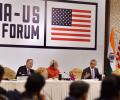
The leaders said trade ties were still fragile

Secretary Tillerson met with Foreign Secretary Jaishankar on Friday to discuss the US-India relationship and the agenda for Prime Minister Modi's meetings at the White House on June 26, a State Department spokesman said told PTI.
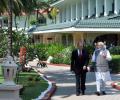
Big ticket defence deals including purchase of missile systems, frigates and joint production of helicopters were sealed on Saturday.
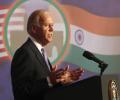
United States President-elect Joseph Biden has always been a strong supporter of India and India-US partnership since his days in Senate and later as a Vice-President.

Terming the Indo-US civilian nuclear deal as "unique to India and not a model to replicate", a senior Bush administration official said the United States is committed to cooperate with Pakistan in enhancing its energy needs but "a civilian nuclear deal with it was not on the table".

India on Thursday secured Mexico's backing in its bid to become member of the Nuclear Suppliers Group as it aggressively scouted for support ahead of a crucial meeting of the 48-nation nuclear trading bloc in Vienna.

India as the G20 host has a 'unique role' to play in bringing about an end to the war in Ukraine due to its 'longstanding historical' ties to Russia, the United States has said, expressing hope to work closely with New Delhi to find a way to stop the conflict.

The Confederation of Indian Industry (CII) on Thursday said it believes that India-US bilateral economic ties would be a high priority for President Joe Biden-led administration in America. "The Indian industry feels that with President Biden and Prime Minister (Narendra) Modi at the helm, the two countries would play a strong role in re-shaping the global economic agenda together," CII president Uday Kotak said. Congratulating Biden on assuming charge as the 46th President of the US, Kotak said, "President Biden's experience in re-building the US economy during the Great Recession would help strengthen the US and global economic recovery in the aftermath of the pandemic."

Hydrography (underwater geography) prevents the Indian Navy for opting for an all-conventional, or all-nuclear submarine fleet.

Atul Keshap would be 'a superb fit for Sri Lanka as he knows the ins and outs of the politics there and all the political players, including the new disposition in Colombo intimately,' US diplomatic sources in Washington, DC told Aziz Haniffa/Rediff.com
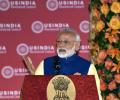
The prime minister said that a larger Indian economy has multiple benefits for the world

Prime Minister Narendra Modi has met his Australian counterpart Scott Morrison in Washington, DC, ahead of the first in-person Quad meeting to be hosted by US President Joe Biden and discussed a broad range of issues of bilateral, regional and global importance, including the Indo-Pacific.

'Washington appears to be playing the long game, and making the argument to India that over the longer term, Russia -- sanctioned, cash-strapped, isolated by the West -- will no longer be a viable defence partner for India'

Prime Minister Narendra Modi has favoured broadening of the strategic partnership with Russia in nuclear, defence and energy sectors and invited President Vladimir Putin to visit Kudankulam atomic power project during his trip in December for his annual summit.

Both the countries discussed issues of mutual interest like comprehensive economic partnership, high level structured energy dialogue, cooperation in mining and earth sciences, social security agreement, civilian nuclear cooperation at the 6th round of Annual Bilateral Trade Policy Consultations that concluded in Ottawa on Thursday.

This is the joint statement issued by the ministry of external affairs on the visit of US President Barack Obama to India.
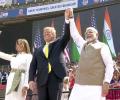
Trump's visit symbolised heightened partisanship and a return to chemistry between leaders defining bilateral ties, notes Kashish Parpiani.

An India-Japan joint statement said the two leaders expressed serious concern over the conflict and the unfolding humanitarian crisis in Ukraine.

Making it easier to do business is a key element of our strategy, says Foreign Secretary S Jaishankar.
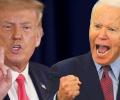
Irrespective of the outcome of Tuesday's keenly-contested US presidential election, America's strategic relationship with India is expected to maintain the current momentum and strengthen further, policy documents and remarks from the two campaigns indicate.
Amidst uncertainties looming over the fate of Indo-US nuclear agreement, the US has asked India to go for some "tough choices" in making the deal a possibility. "President Bush pressed for the civilian nuclear agreement with India against strong opposition because he's committed to our long-term strategic partnership. Now India needs to make some tough choices," Commerce Sectary Carlos Gutierrez has said.

Boosting trade and simplifying visa regime, apart from security and defence cooperation, were among the key bilateral issues. The two leaders also discussed regional and international matters of mutual interest.

'If the Russian forces do capture Kyiv and set up some sort of provisional government, they might run into an insurgency, for which the geography is just right, it could prove costly for them.' 'In that event, the whole exercise could turn out to be counter-productive -- and costly in both foreign policy and domestic terms.'
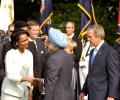
The night before Dr Singh was to meet President Bush, he said he could not sign the agreement.
Congressman Frank Pallone, the founder and former co-chair of the Congressional Caucus on India and Indian Americans, believes the Bush Administration and Congress blundered by selling the US-India civilian nuclear agreement as a nuclear and not as an energy deal. Pallone also argues that the deal was projected as a sign of the burgeoning strategic partnership between India and the US, which raised the hackles of the Leftists in the government.
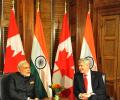
Canada will supply uranium to energy-starved India beginning this year over a period of five years, a decision which was termed as a launch of a new era of bilateral cooperation and mutual trust by Prime Minister Narendra Modi.
The prime minister also talked about increasing the trade volume and transforming the nature of economic ties and expressed concern over religious extremism and terrorism in its neighbourhood.
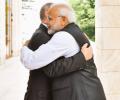
Modi said India and Russia have been friends for a long time and thanked Putin for inviting him for the first-ever informal meeting at Sochi.
Pakistan's Prime Minister Shaukat Aziz on Tuesday called for a "strong and vibrant" Pakistan-China economic partnership to promote comprehensive cooperation, especially in the field of nuclear power generation.

A framework agreement on Jaitapur Nuclear Power Project (JNPP) is expected to be signed between the two sides during the visit.

India and the United Kingdom on Thursday announced deals worth 9 billion Pound (Rs 90,550 crore) as they signed a civilian nuclear pact and decided to collaborate in the field of defence and cyber security besides launching a railway rupee bond in London.

Ami Bera is on cloud nine after being part of Obama's visit to India.

"We are committed to building a new India. We have to do this as early as possible," he said.
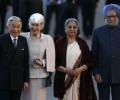
In recent years India-Japan relations have acquired rich economic content and strategic intents. Although the bilateral trade at $18 billion between the two countries is not very impressive and leaves much to be desired, the economic engagement between the two countries is both qualitatively and quantitatively noteworthy. India-Japan defence cooperation, however, has generated a lot interest among the strategic community in the context of rise of China. There has been a lot of speculation about India-Japan strategic partnership to hedge China, says Rup Narayan Das.

There has been no official announcement from either the White House or the Prime Minister's Office in New Delhi.

The meeting between United States Ambassador to India Nancy Powell and Gujarat Chief Minister Narendra Modi was a "pragmatic" and "necessary step", according to a media report, that said it seems "likely" the visa status of BJP's prime ministerial candidate "could change" if he is elected to the top post.

Modi, who is leaving for Iran on Sunday, will also pay a two-day visit to Qatar from June 4.

'China might soon have to seriously consider whether it prefers an Indo-US hyphenation to a Sino-Indian one.'
